Why a Data Cable Protective Cover Saves Your Charging Cords
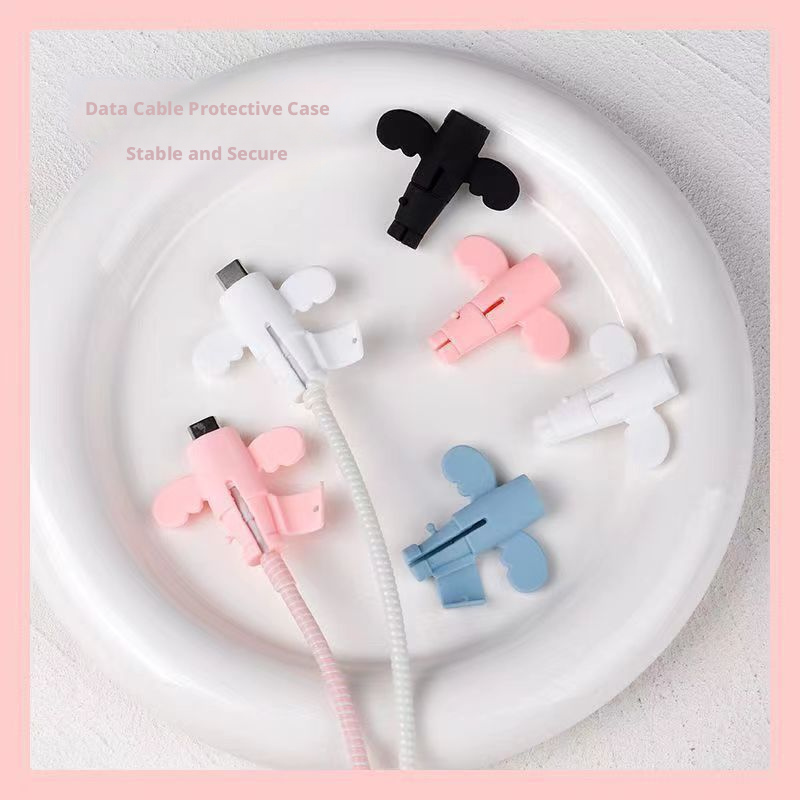 Data Cable Protective Cover-little Angel Model-pink-1 Piece$1.99Shop →
The Weak Point Every Charging Cable Shares
If you have ever had a charging cable die on you, chances are it failed in the same place: right where the cord meets the plug. That short section bends every time you tuck your phone into a bag, charge in bed, or yank the cable out at an angle. Over hundreds of cycles, the insulation cracks, the wires inside stretch, and eventually the cable stops carrying power reliably. A data cable protective cover is a small accessory designed to address exactly that failure point.
What a Cable Cover Actually Does
A cable protective cover is a flexible sleeve, usually made of soft silicone or rubber, that wraps around the strain-relief area near the connector. Its job is mechanical: it spreads out the bending force across a longer span so the cord curves gently instead of kinking sharply at one spot. Many covers, like this pink design, also add a bit of personality, making it easier to spot your own cable in a household full of identical black cords.
- Bend protection at the most vulnerable junction
- Visual identification so you grab the right cable
- A grip surface that makes unplugging easier and gentler
Choosing One That Fits
The most important thing to check is connector compatibility. Covers are shaped to slide over a specific plug style and the molded housing behind it. Before buying, look at the shape of your cable's connector head and compare it to the product's intended fit. A cover that is too loose will slip off; one that is too tight may not seat fully. Soft, pliable material is generally easier to install and more forgiving across slightly different cable thicknesses.
Fitting and Everyday Care
Installation is usually as simple as easing the cover over the connector and sliding it back until it hugs the strain-relief section. Take your time so you do not tug the cord itself. Once on, the cover stays put through normal use.
Keep it working longer
- Unplug by holding the connector or the cover, never by pulling the cord
- Avoid coiling the cable tightly around the plug end when storing it
- Wipe the cover with a slightly damp cloth if it picks up pocket lint or grime
It is a tiny, inexpensive upgrade, but because cables tend to fail at one predictable spot, a protective cover can meaningfully stretch the working life of a cord you would otherwise be replacing.
FAQ
- Will this cover fit any charging cable?
- Not necessarily. Covers are shaped for a particular connector style and the molded housing behind it. Check that the shape matches your cable's plug before buying, since fit is what keeps the cover in place and effective.
- Does a cable cover affect charging or data speed?
- No. The cover only wraps the outside of the strain-relief area near the plug. It does not touch the metal contacts or the wiring inside, so charging and data transfer are unchanged.
- Can I move the cover to a new cable later?
- Usually yes, if the new cable has a similarly shaped connector. Soft silicone covers can be carefully slid off one cable and onto another, though a snug original fit may stretch slightly with repeated moves.